Audit

Lloyd's is keen to promote both high standards and consistency in the audit of its coverholders and Delegated Claims Administrators (DCAs).

Lloyd’s Coordinated Audits

Lloyd's is dedicated to promoting both high standards and consistency in the audit of its Coverholders and Delegated Claims Administrators (DCAs). To ensure consistency of approach, Lloyd’s has worked with the Market and the LMA to produce a standardised LMA Coverholder and DCA Audit Scope. Furthermore, Lloyd’s facilitates the coordination of audits on behalf of Managing Agents when there are two or more Managing Agents with a lead binding authority agreement. This coordinated approach helps reduce the regulatory burden associated with multiple annual audits for Coverholders and DCAs with several Lloyd’s leads. Since 2018, this process has been streamlined through the Delegated Audit Manager (DAM), an online platform that automates the coordination of audits. 


Why is a Coverholder / DCA audited and what does it involve? 

Audits ensure that Coverholders and Delegated Claims Administrators (DCAs) operate in line with their binding authority and service agreements. Using a risk-based approach, Managing Agents verify that insurance contracts are correctly issued and claims properly adjusted. Onsite audits assess adherence to internal policies and contractual terms, while also identifying opportunities to reduce risk and enhance operational efficiency. Audits will also identify areas where the Coverholder / DCA can reduce risk or improve efficiency.


Audit/ Delegated Audit Manager Acronyms

  • AAR/TAAR- Audit Action Review
  • AFR/TAFR- Audit Findings Request
  • AQC/TAQC- Auditor Quoting Case
  • AQR/TAQR- Audit Quote Review
  • APC/TAPC- Audit Processing Case
  • ASV/TASV- Audit Site Visit
  • CAR/TCAR- CAF Audit Rationalisation
  • CAI/TCAI- Carrier Audit Invoice
  • CFR/TCFR- Carrier Finding and Recommendation
  • CAA/TCAA- Coverholder/TPA audit action
  • RFI- Request for Information
  • MSC/TMSC- Master Scheduling
  • LCA- Large Coordinated Audit
  • US/TUSI- Update Scheduling Information
  • CAF- Central Audit Function
  • SLA- Service Level Agreements
  • TPA/DCA- Delegated Claims Administrators

*There are two types of audits on DAM, Coverholder and DCA. If a task begins with a “T” – means the task refer to a TPA / DCA Audit.


DAM workflow - end to end process:

The Lloyd’s annual coordination process and its associated Service Level Agreements (SLAs), agreed by Managing Agents, are designed to ensure the end-to-end audit assignment is completed within a maximum of six months, from scoping to post-audit action issuance. Timely delivery of the annual plan enables effective scheduling of future audits and ensures sufficient time to close one assignment before initiating the next.
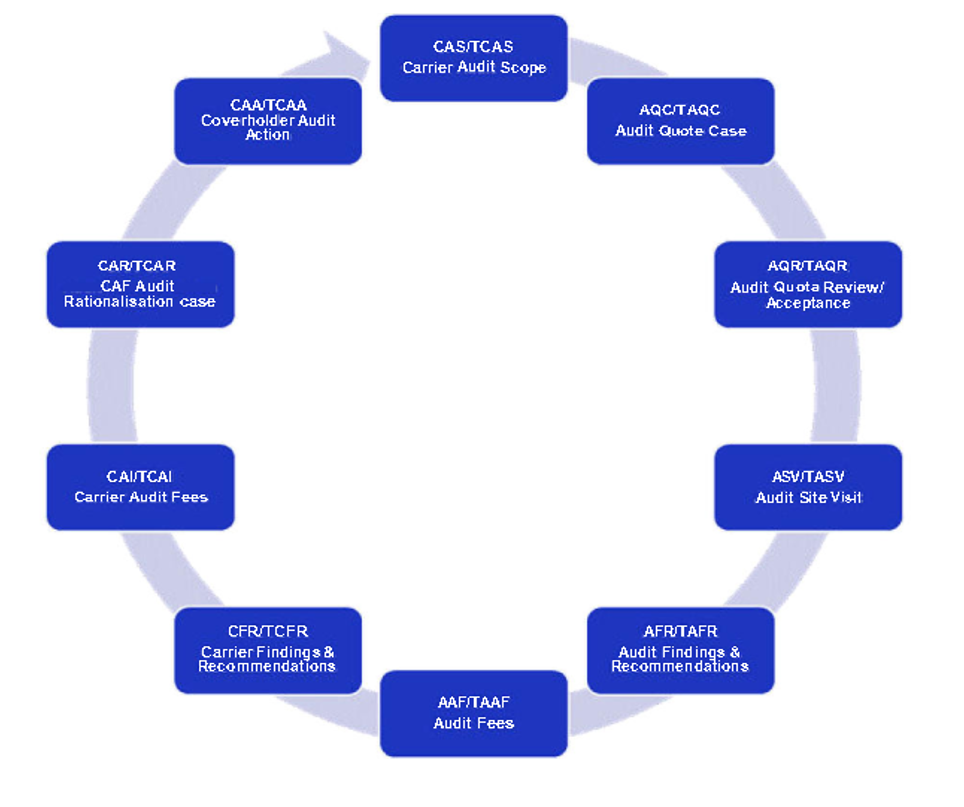
Circular diagram illustrating the DAM end-to-end workflow process. The process begins with ‘Carrier Audit Scope,’ followed clockwise by ‘Audit Quote Case,’ ‘Audit Quote Review/Acceptance,’ ‘Audit Site Visit,’ ‘Audit Findings & Recommendations,’ and ‘Audit Fees.’ The workflow then continues into carrier-related steps: ‘Carrier Findings & Recommendations,’ ‘Carrier Audit Fees,’ ‘CAF Audit Rationalisation Case,’ and ‘Coverholder Audit Action,’ before looping back to ‘Carrier Audit Scope,’ showing a continuous audit lifecycle.
close
Circular diagram illustrating the DAM end-to-end workflow process. The process begins with ‘Carrier Audit Scope,’ followed clockwise by ‘Audit Quote Case,’ ‘Audit Quote Review/Acceptance,’ ‘Audit Site Visit,’ ‘Audit Findings & Recommendations,’ and ‘Audit Fees.’ The workflow then continues into carrier-related steps: ‘Carrier Findings & Recommendations,’ ‘Carrier Audit Fees,’ ‘CAF Audit Rationalisation Case,’ and ‘Coverholder Audit Action,’ before looping back to ‘Carrier Audit Scope,’ showing a continuous audit lifecycle.

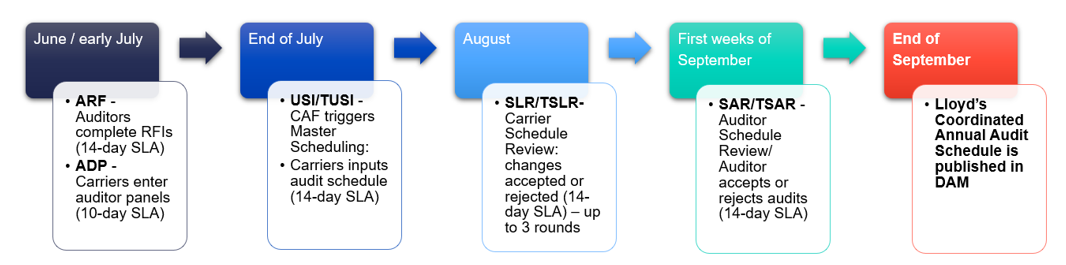
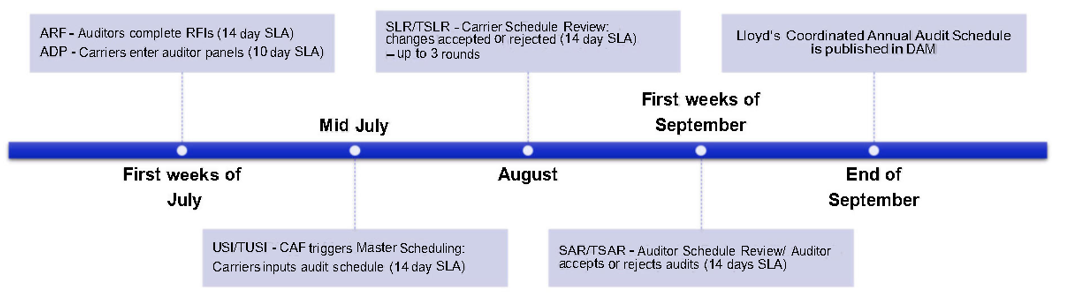
Annual Scheduling process:

Horizontal timeline diagram showing the annual audit scheduling process from June to September. In June/early July, auditors complete RFIs within a 14-day SLA and carriers enter auditor panels within a 10-day SLA. By the end of July, CAF triggers master scheduling and carriers input audit schedules within a 14-day SLA. In August, carriers review schedules, accepting or rejecting changes within a 14-day SLA, with up to three review rounds. In the first weeks of September, auditors review schedules and accept or reject audits within a 14-day SLA. The process concludes at the end of September with Lloyd’s coordinated annual audit schedule published in DAM.
close
Horizontal timeline diagram showing the annual audit scheduling process from June to September. In June/early July, auditors complete RFIs within a 14-day SLA and carriers enter auditor panels within a 10-day SLA. By the end of July, CAF triggers master scheduling and carriers input audit schedules within a 14-day SLA. In August, carriers review schedules, accepting or rejecting changes within a 14-day SLA, with up to three review rounds. In the first weeks of September, auditors review schedules and accept or reject audits within a 14-day SLA. The process concludes at the end of September with Lloyd’s coordinated annual audit schedule published in DAM.
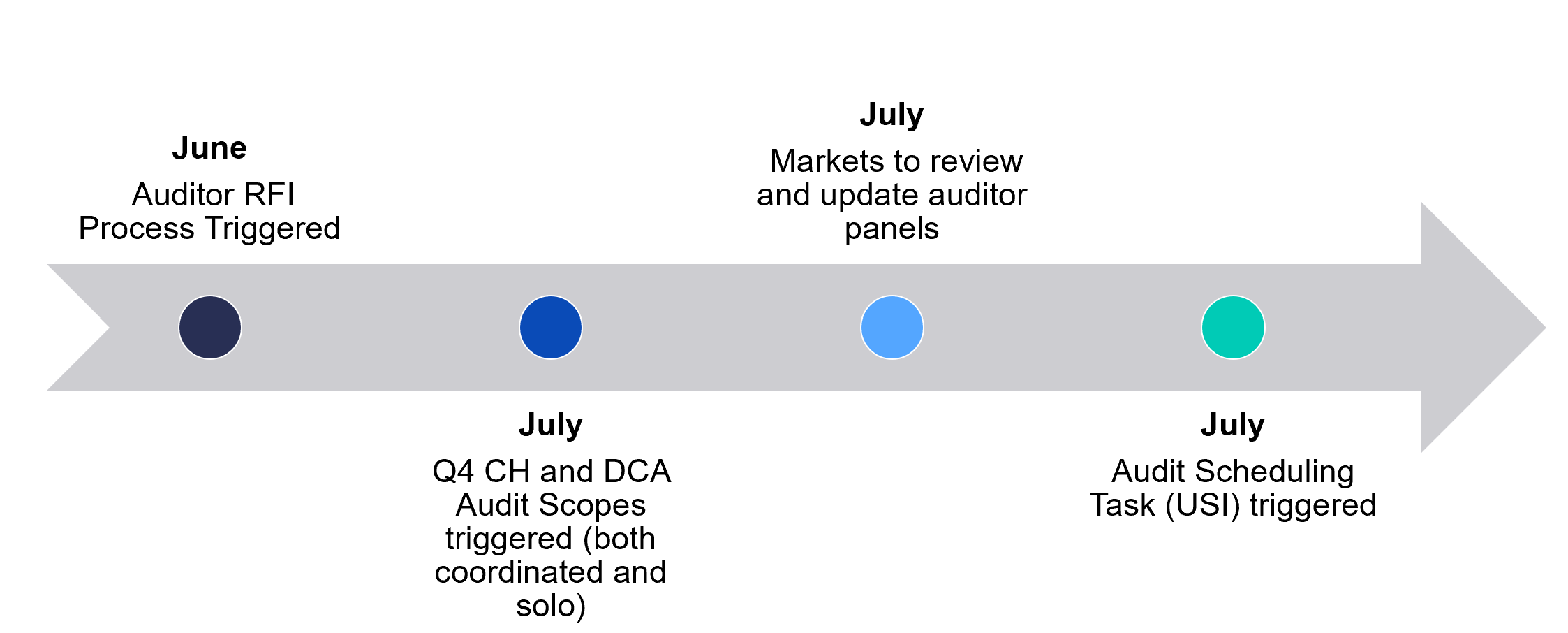
Horizontal timeline arrow showing key audit planning milestones from June to July. In June, the auditor RFI process is triggered. In July, Q4 CH and DCA audit scopes are triggered for both coordinated and solo audits, markets review and update auditor panels, and the audit scheduling task (USI) is triggered, showing progression toward audit scheduling.
close
Horizontal timeline arrow showing key audit planning milestones from June to July. In June, the auditor RFI process is triggered. In July, Q4 CH and DCA audit scopes are triggered for both coordinated and solo audits, markets review and update auditor panels, and the audit scheduling task (USI) is triggered, showing progression toward audit scheduling.

DAM Workflow – Auditor RFI submission timelines:

close

DAM Workflow – Audit Scopes submission timelines:

close

The LMA Audit Scope

The LMA Audit Scope, embedded within DAM, provides a standardised template that allows Managing Agents to select relevant audit sections for each assignment. Bespoke requirements can also be added using the custom scope function. This structure supports coordinated audits, enabling multiple Managing Agents to audit the same Coverholder or DCA simultaneously reducing duplication and avoiding multiple separate audits.

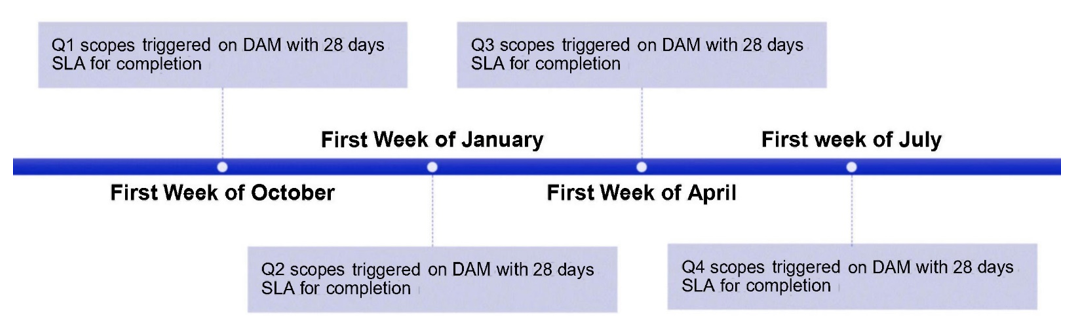
The Audit scoping tasks are triggered via DAM at specific points throughout the year, as outlined in the timeline below.  As part of the scoping task in DAM, managing agents must select the binders to be audited, specify the number of file reviews, and identify the sections of the scope they wish to include in the audit.

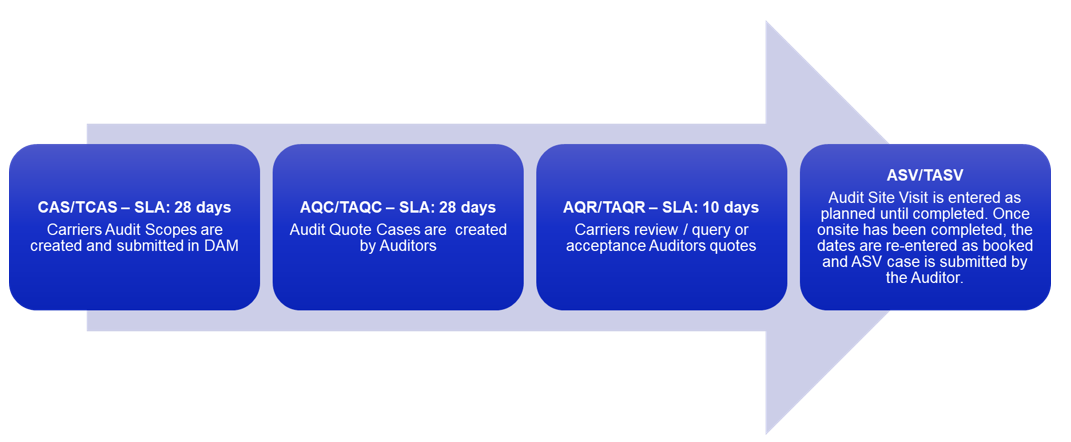
DAM Workflow - Pre – Audit:

close

What happens when the audit is completed?

  • Upon completion of the audit, the auditor will conduct a wrap-up meeting with the Coverholder or DCA to discuss initial findings and explore any immediate solutions.
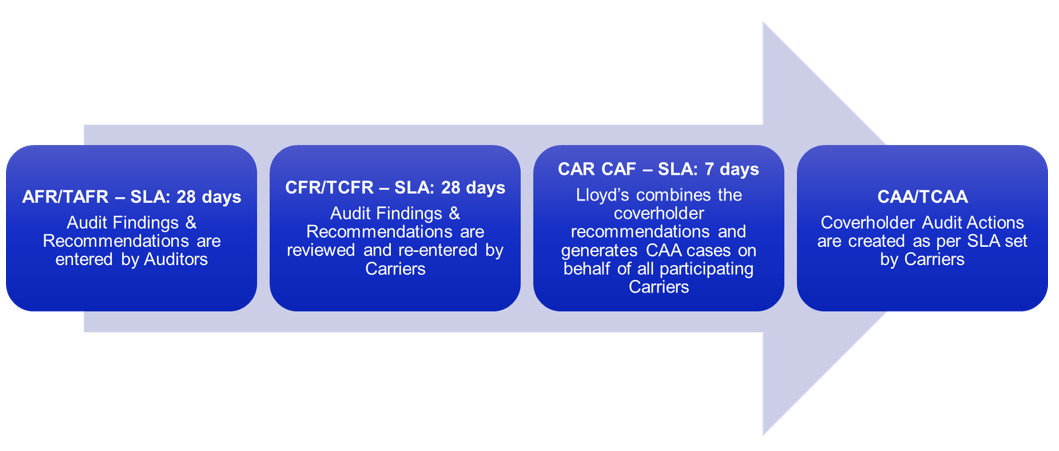
  • A formal audit report is then submitted to the Managing Agent, with recommendations recorded in DAM under the relevant audit assignment. The Managing Agent will review the findings and provide feedback, including any required actions and associated timelines, via a DAM task.
  • If the audit was conducted on behalf of multiple Managing Agents, Lloyd’s Audit Team will consolidate general recommendations to avoid duplication and issue final Audit Actions through DAM.
  • The Coverholder or DCA is expected to respond via their DAM portal, providing any supporting evidence required to enable the Managing Agent(s) to close the recommendations.
  • Please refer to the workflow below for a detailed timeline, including service level agreements (SLAs) for each stage.


DAM Workflow – Post Audit:

close

Contact us

For further information, please feel free to contact us via this inbox.