2026 Half Year Results
View the results in detail.
03 September 2026
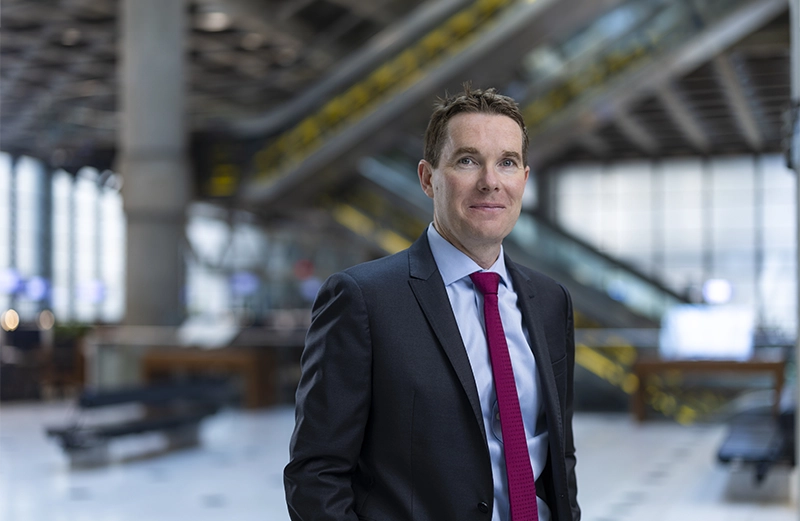
The market has produced a solid result for members over the first half of the year, our outlook for 2026 is unchanged and the pipeline of high-quality underwriting talent looking to join Lloyd’s remains strong.Patrick Tiernan, Chief Executive
The first half of 2026 has provided further evidence we are now operating in a world that is structurally disorderly rather than just passing through a period of heightened volatility.
The infrastructure foundations on which our industry has based many of its assumptions over the past 80 years are becoming less stable. We see this across four main areas: physical infrastructure; data and cyber infrastructure; financial, banking and clearing infrastructure; and the rules-based infrastructure on which global trade is based.
None of the threats to this crucial infrastructure is wholly new. What is unprecedented is that they are all in play at once, interacting and compounding in ways that are difficult to anticipate.
Against that backdrop, the syndicates operating in the Lloyd’s market delivered a solid aggregate set of results for the six months ended 30 June 2026. Gross written premium increased by 6.9% (HY 2025: 6.2%), driven by growth from new business and new entrants to the market. A combined ratio of 90.8% (HY 2025: 92.5%) drove underwriting profit of £1.9bn (HY 2025: £1.5bn).
Investment return was weaker than expected at £1.8bn (HY 2025: £3.2bn) due to unrealised losses on the fixed income portfolio as a result of increasing yields.
Profit before tax of £3.5bn (HY 2025: £4.2bn) was in line with guidance and 16.8% lower than the same period in 2025.
This is a solid start to the year. But strong performance and high risk are far from mutually exclusive. From a pricing and risk environment perspective, we see the outlook weighted to the downside from this current high point in performance. Underwriting discipline and innovation are the keys to maintaining outperformance and quality of earnings.
Rates across the Lloyd's market declined by (6.7)% in the first half. While our assessment of long term rate adequacy remains above the level required to deliver a 95% net combined ratio, the continuing erosion of adequacy in core markets comes as an array of risk signals are flashing more urgently.
Our outlook for the full year is unchanged. We continue to expect gross written premium of £64bn (plus or minus 5%) and a combined ratio of between 90% and 95%.
Notwithstanding the current El Niño conditions and lower predictions for the North Atlantic hurricane season, the underlying pressures on physical infrastructure continue to build. Infrastructure is ageing. Threats from fire, flood and drought are being driven or amplified by climate change. Demographic shifts, the rising value of assets and legal system abuse have resulted in inflated claims costs. Incidents of terrorism, political violence and acts of war are on the rise. The industry has decades of experience in understanding and underwriting many of these physical risks. But their frequency, severity and concentration are all increasing.
Economies are more reliant than ever on digital infrastructure like cloud infrastructure and subsea cables. Meanwhile, cyber warfare and the weaponisation of AI are increasing both the range of potential threats and the speed at which they can develop.
Banking, clearing systems and other financial infrastructure create potential chokepoints through which geopolitical and economic pressure can be applied. Sanctions and other forms of economic warfare can have consequences well beyond their intended targets. We saw this after the invasion of Ukraine, particularly in aviation losses, even where the underlying physical risk had not fundamentally changed.
Finally, there is every possibility the international order could fragment further over the coming years, with less global consensus and more unilateral state action. That could result in heightened geopolitical instability, faster-moving conflicts and reduced warning time as diplomacy becomes less effective.
In parallel, a more self-interested global environment may drive greater use of tariffs, sanctions and trade restrictions, creating economic volatility, fiscal pressure and weaker global growth.
The industry has experience of many of these individual threats. We have much less experience of managing so many of them simultaneously. Physical damage can trigger cyber disruption; cyber attacks can disable financial infrastructure; sanctions can alter the insurability of assets overnight; and geopolitical fragmentation reduces the possibility of multi lateral approaches to managing these risks.
The continuing conflict in the Middle East has been a prime example. First and foremost, there is the human cost and continuing uncertainty for communities across the region. But the commercial and insurance implications are also significant.
Our experience of past major events in the region and elsewhere has informed our modelling and response. We continue to assess not simply current exposures but how the situation might evolve, including through the development of second-order effects driven by inflation, energy security, affordability and availability, sanctions, supply chain stress and wider economic disruption.
But our role cannot simply be to understand risk. Rather it must be to help our stakeholders navigate it. Notwithstanding some frustration and misinterpretation in the days immediately following the outbreak of hostilities at the end of February, the Lloyd’s market has continued to provide cover and expert advice to its clients throughout the conflict.
This was the market yet again doing what it does best: bringing both expertise and capital to bear on a crisis so that commerce can continue even when uncertainty is at its greatest.
Underwriters worked through the initial weekend, some sleeping in their offices, as they continued to assess and quote maritime and other relevant risks.
Here was further proof of their dedication to long-standing customer and broker relationships.
The quotes kept coming, even when shipowners chose not to take them up because the risks to crews and vessels were simply too great. The market has also responded with additional capacity, including new marine war facilities (for example, those led by Chubb and Beazley) to prepare for a range of potential scenarios. This was the market yet again doing what it does best: bringing both expertise and capital to bear on a crisis so that commerce can continue even when uncertainty is at its greatest.
At the Corporation, we proactively engaged with governments around the world and their London embassies to share critical insight on market dynamics and risk intelligence. It is a delicate balance to advocate for the market while maintaining discretion and retaining the trust of those making critical decisions.
We will work with the market to make our terminology clearer and prevent any confusion at critical moments. Thank you for your continuing trust. There are lessons to be learned in every crisis, but rest assured, we will always work tirelessly with the market's wellbeing and long-term interests at heart in such situations.
Based on exposures and damage observed to date, we do not currently expect the situation to constitute a capital event for the Lloyd’s market or to have a material impact on the P&L.
At the time of writing, transits through the Strait remain significantly below pre-crisis levels. We continue to monitor the situation closely and evaluate a range of possible scenarios for the evolution of the current conflict.
Moving to other major losses in the period, global insured losses from natural catastrophes in the first half have been reported at around $44 bn, below recent inflation-adjusted averages. At Lloyd’s major losses were £1.4bn, 32% below H1 2025.
Yet that relatively benign headline masks a more important fact: only around 40% of global economic losses from natural disasters were insured. This stark fact points to a broader challenge.
The insurance industry is continually challenged about the “protection gap” – the widening difference between economic losses and insured losses.
It’s a reasonable concern. Data shows that countries with deeper insurance penetration tend to allocate capital more efficiently, recover from shocks faster and enjoy longer periods of growth. There is a direct correlation between insurance take up and economic performance.
The picture varies in different parts of the world. In developing countries, lower incomes, less mature insurance markets and different economic structures can make it very difficult for private insurance alone to provide sufficient protection.
State intervention is often necessary to make risks insurable or coverage affordable. One example is the Insurance Development Forum’s great work in structuring a CAT bond to help Jamaica stabilise its credit rating following the economic devastation of Hurricane Melissa.
And, even in advanced economies, some risks have become too expensive for many households and businesses to reasonably bear.
In such circumstances, government or state backed schemes have been effective in providing relief from extreme tail or systemic events. Prime examples include TRIA and Pool Re for terrorism and NFIP and Flood Re for flood.
Governments also intervened on an extraordinary scale during the financial crisis and the pandemic. But past intervention is no guarantee of future capacity. Public finances are under increasing pressure just as the potential scale and range of systemic risks are growing.
Yet across many advanced economies, some companies are deciding not to take out insurance where it is available. And not every decision to go uninsured or underinsured is necessarily the product of an affordability calculation. There is also an assumption that failure to protect the company’s assets will go unpunished, or worse, that poor risk management decisions, wilful or otherwise, will be rewarded with protection from public funds. Alongside the protection gap, we therefore need to consider a “perception gap”: the difference between who believes they will bear a risk and who will actually shoulder it when the loss occurs. Closing that gap requires greater clarity about who is responsible for what.
Governments play an essential role – especially where extreme tail risks exceed reasonable commercial capacity. But the guiding principle here must surely be that the state provides protection for those that cannot afford it, not those who choose not to pay.
Providing clarity about this would help in two ways. First, it would mean that public resources are more likely to be directed towards those who cannot protect themselves (rather than to risk takers who are inclined to privatise any upside and socialise any downside).
Second, it would make sure that those risks that can be insured are covered by private capital, thereby spreading risk across a larger pool of policyholders and a broader base of capital, helping improve affordability over time.
There is a huge opportunity, at a time when the market is softening but profits are at record levels and capital is being drawn to our industry, to make the economic case for greater use of insurance, not simply to provide protection when things go wrong, but to prevent losses, improve resilience and support stronger economic performance. I believe Lloyd’s has a central role to play around the world to make the economic argument for growth driven by more informed allocation of insurable risk to private capital.
Another avenue for structural growth for the industry must be in following the investment of private and public capital in the areas of defence, energy and infrastructure. The growing concentration of capacity in core markets suggests we are in danger of missing this opportunity, with competition driving capital towards familiar risks – weakening terms and pricing – rather than towards the new risks emerging around us.
Meeting these challenges will require us to harness the full power of the Lloyd’s market to help manage the risks others cannot. That will require us to move beyond isolated innovations in products, capital or structures.
Instead, we must work towards total innovation with the whole system operating in concert to expand the boundaries of the possible. The aim is to make innovation the natural operating rhythm of the market, so that Lloyd’s reflexively embraces emerging and complex risks as potential opportunities.
We are working to demonstrably expand our appetite, making it easier for syndicates and members to pursue opportunities where they see a clear economic case for growth, innovation or reimagining risk to close both the protection and perception gaps.
Such ambition can never come at the expense of underwriting discipline. As the pricing cycle softens, we are becoming increasingly selective about business entering the market. As ever, all applications are assessed against our combined ratio and return on capital requirements.
We are currently turning away more new business than we accept. Only about 20% of the applications received by third party managing agents are passed on to Lloyd’s. And, of those that reached us last year, we declined £5.1bn worth of business.
Our objective is neither to constrain the market nor impose a single view of risk. Lloyd’s will remain open to new businesses and new capital – we want attractive risks to come to this market – but growth must be accretive and margins adequate.
We will not pursue growth or premium for its own sake. We will take a differentiated and proportionate approach to oversight. Syndicates with strong cycle-management capabilities should have greater freedom to deliver disciplined plans. Where capability or underwriting discipline is weaker, oversight will increase as conditions become more challenging.
Let there be no doubt: underwriting discipline starts with the market itself. It should be inherent in how managing agents run their businesses; Lloyd’s oversight will escalate where this is absent
Growth must be accretive and margins adequate. We will not pursue growth or premium for its own sake.Patrick Tiernan, Chief Executive
The strategy we launched in March is similarly focussed on the primacy of the market. It is focussed on deploying Lloyd’s distinctive strengths to deliver four outcomes: leading underwriting performance; an efficient and flexible marketplace; maximising Lloyd’s capital advantage; and building a Lloyd’s to be proud of.
Delivering it requires us to do two things simultaneously: protect and advance the market.
Protecting the market means maintaining the stability, discipline and service on which Lloyd’s reputation depends. Advancing the market requires us to reduce the cost and friction of operating at Lloyd’s, provide greater flexibility, modernise our use of technology and data, and build the capabilities required for future innovation.
I’m convinced that, in the current environment, the risk of doing nothing is greater than that of waiting. That means the safest course of action is to be bolder.
We must preserve confidence and performance while moving faster where change will make Lloyd’s stronger.
We will fund that change responsibly. Our “save to invest” commitment means we will be making the hard choices within the Corporation’s existing cost base: stopping or scaling back work that does not support our strategic outcomes and redirecting resources towards the capabilities that matter most to the market.
We will report progress transparently, including structured updates at the half-year and full-year results and the annual general meeting.
In addition:
In July, we concluded the investigation into the former Lloyd’s Chief Executive and other senior leaders in the Corporation. The investigation identified conduct and governance failures that fell well below the standards we expect at Lloyd’s, including serious failures in the handling and escalation of whistleblowing reports.
I want to thank those who supported the investigation, particularly the witnesses and whistleblowers who came forward.
We have acted on the findings of the investigation. Following a review commissioned by Sir Charles Roxburgh shortly after taking up his role, we have strengthened Council oversight, revised committee structures and senior appointment procedures, enhanced disclosure requirements and introduced a formal duty of candour for me as Chief Executive. We have also strengthened our management of conflicts and the escalation of whistleblowing reports and have updated the Lloyd’s Code of Conduct.
Processes and structures matter, but they are only part of the answer. Trust and integrity ultimately depend on culture, judgement and personal accountability. Everyone at Lloyd’s, whatever their seniority, has a responsibility to uphold the standards we expect, and anyone who raises a concern must have confidence that it will be heard and acted upon.
The market has produced a solid result for members over the first half of the year, our outlook for 2026 is unchanged and the pipeline of high-quality underwriting talent looking to join Lloyd’s remains strong.
However, the 2027 planning season will be different. As the underwriting conditions become more challenging, we should not expect growth in core markets. Our priority must be to protect underwriting quality and sustainable returns.
That makes innovation more important, not less. If growth in established areas becomes harder to justify, we need to be better and faster at finding the risks where Lloyd’s expertise and capital can make a genuine difference.
We need to create new opportunities rather than lower our standards to pursue old ones.
Before I conclude, I would like to express my thanks.
To the market, for your continued trust and for delivering consistently strong results.
To our members, whose continuing capital support makes everything this market does possible.
To my colleagues at Lloyd’s: thank you for your commitment and resilience and for the trust you continue to place in the organisation and in each other. Seeing that reflected in our latest engagement score has been a personal highlight of the first half of this year.
And, lastly, to all our stakeholders around the world who rely on Lloyd’s and place their trust in this market: thank you.
There will be harder choices ahead. We are fortunate to be able to make them from a position of strength, clear about the standards we expect, the opportunities we want to pursue and the role Lloyd’s can play in helping society face the risks ahead.
Thank you. Stay safe and well.
Chief Executive